


The Article has been published on Ryukyu Shimpo as of today (19th November 2026)
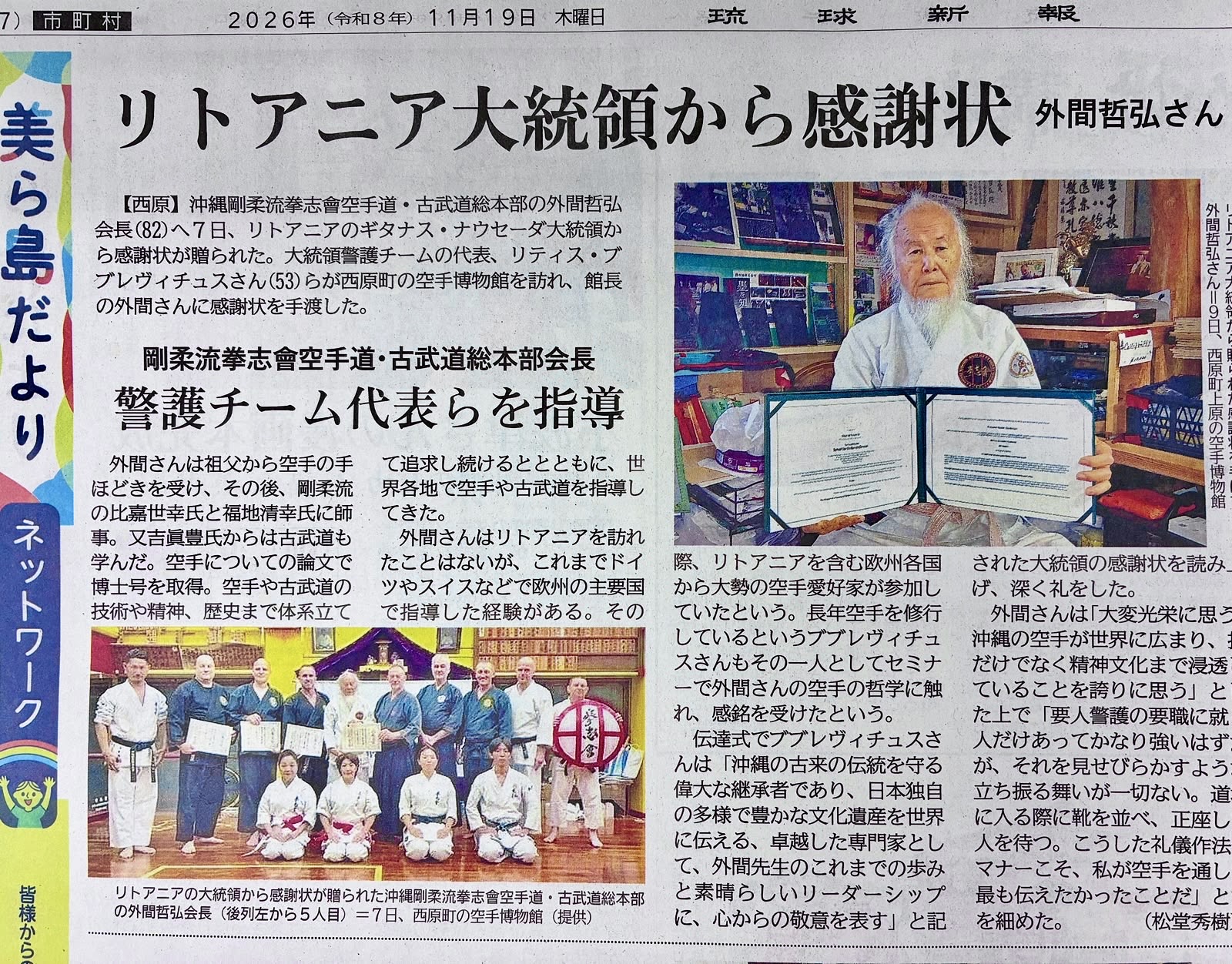
Lithuanian President Presents Letter of Appreciation to Tetsuhiro Hokama
President of the Okinawa GojuRyu Kenshikai Karatedo Kobudo Headquarters
Hokama Instructs Members of the President’s Security Team
NISHIHARA, Okinawa — On the 7th, Tetsuhiro Hokama, 82, President of the Okinawa GojuRyu Kenshikai Karatedo Kobudo Headquarters, received a letter of appreciation from Lithuanian President Gitanas Nausėda.
Rytis Bublevičius, 53, representative of the President’s Security Team, and other members of the delegation visited the Karate Museum in Nishihara Town and personally presented the letter to Hokama, who also serves as the museum’s director.
Hokama first learned the fundamentals of karate from his grandfather. He subsequently studied under Goju-Ryu masters Seikō Higa and Seikō Fukuchi. He also studied traditional Okinawan martial arts, known as Kobudo, under Shinpo Matayoshi.
He earned a doctoral degree through his academic research on karate. Throughout his career, he has continued to systematically explore the techniques, philosophy, spirit, and history of karate and Kobudo, while teaching these disciplines in countries around the world.
Although Hokama has never visited Lithuania, he has previously taught in major European countries, including Germany and Switzerland. On those occasions, numerous karate enthusiasts from across Europe, including Lithuania, participated in his seminars.
Bublevičius, who has practiced karate for many years, was among those participants. Through Hokama’s seminar, he encountered the philosophy of Okinawan karate and was deeply impressed by its teachings.
During the presentation ceremony, Bublevičius read aloud the letter of appreciation from the Lithuanian President, which stated:
“We express our heartfelt respect for Hokama Sensei’s lifelong dedication and outstanding leadership. He is a great inheritor and guardian of Okinawa’s ancient traditions, as well as an exceptional expert who shares Japan’s unique, diverse, and rich cultural heritage with the world.”
After reading the letter, Bublevičius bowed deeply in a gesture of respect.
Hokama expressed his gratitude, saying:
“I feel deeply honored. I am proud that Okinawan karate has spread throughout the world and that its influence extends beyond physical techniques to encompass its underlying spiritual and cultural values.”
He continued:
“People who hold senior positions in the protection of dignitaries are naturally expected to be exceptionally strong. Yet, despite their abilities, they display no arrogance or desire to show off their strength.
When entering the dojo, they neatly arrange their shoes and sit formally in seiza while waiting for others.
These forms of etiquette, discipline, and proper conduct are precisely what I have wanted to communicate most through karate.”
Hokama concluded with a gentle smile.
By Hideki Matsudo
Photo Caption 1
Tetsuhiro Hokama, President of the Okinawa Goju-Ryu Kenshikai Karate-do and Kobudo Headquarters (fifth from the left in the back row), together with the delegation, following the presentation of the letter of appreciation from the Lithuanian President.
November 7, Karate Museum, Nishihara Town. (Photo provided)
Photo Caption 2
Tetsuhiro Hokama holding the letter of appreciation presented by the Lithuanian President.
November 9, Karate Museum, Uehara, Nishihara
Interview
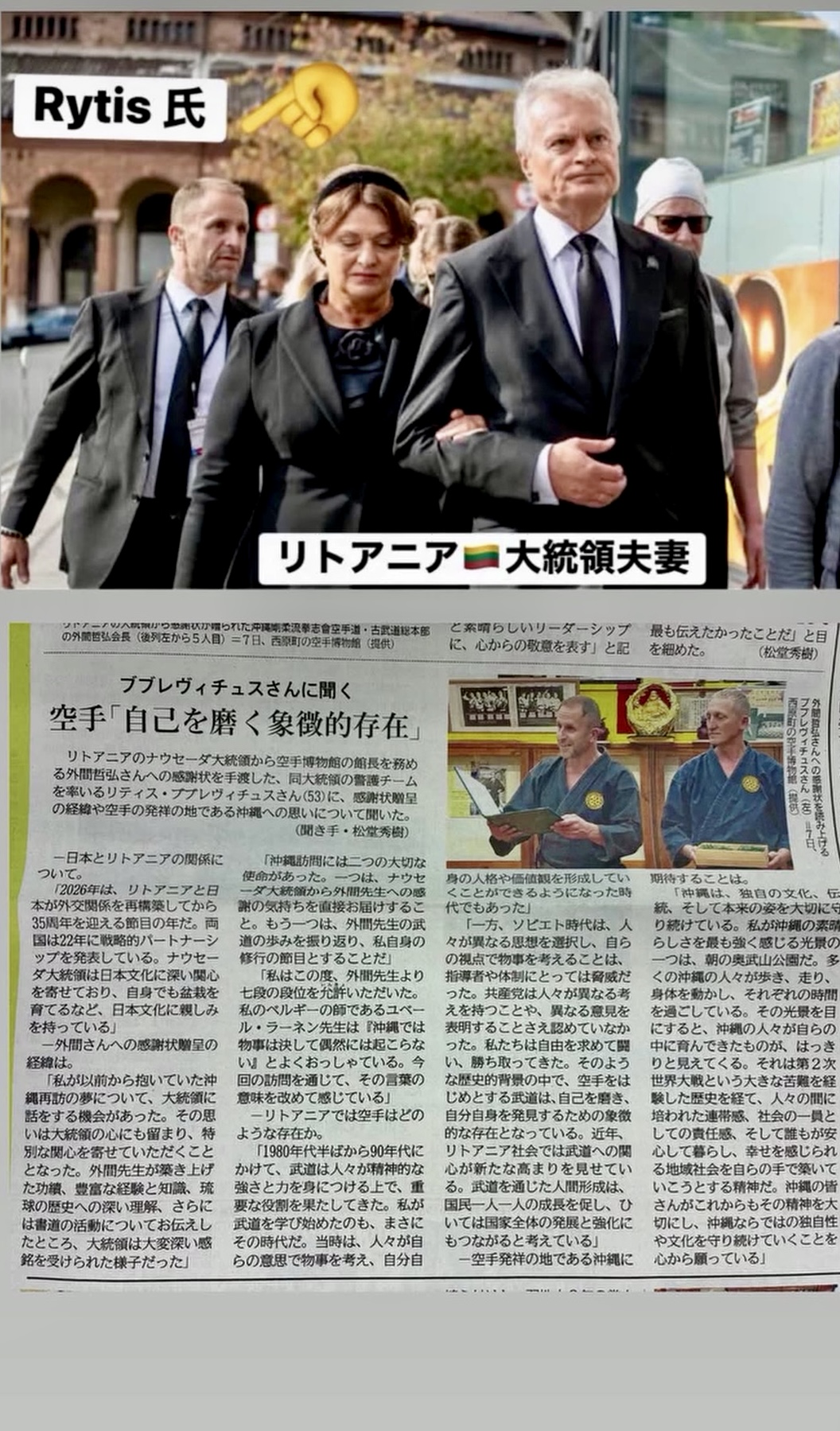
Screenshot
This is Rytis sensei’s interview article.
1.
The trip to Okinawa took me several years to get back here. I had to prepare and plan this wonderful trip. I am very excited to visit this wonderful country again, meet people, deepen my knowledge, and discover new things.
I can also note that 2026 is the 35th anniversary of the re-establishment of diplomatic relations between Lithuania and Japan. And in 2022, Lithuania and Japan announced a strategic partnership between the two countries. The President is interested in Japanese culture, which is close to his heart, and personally grows Bansai trees.
I briefly talked about my dream of visiting Okinawa again with the country’s President and First Lady. So it did not go unnoticed and received exceptional attention. Because the planned visit to Hokama Sensei and his life achievements, experience, knowledge of Ryukyu history, and calligraphy left a great impression.
So I had two missions: to convey the gratitude of the President of Lithuania, Gitanas Nausėda, and to summarize my martial arts studies, holding the 7th Nana dan degree at Hokama Sensei Sohombu dojo.
As my direct teacher from Belgium Hubert Laenen says, nothing happens by chance in Okinawa.
2.
Martial arts were a key factor in building strength and power in the mid-1980s and 1990s. My studies began during that time, when many people had the opportunity to discover and develop their character on their own. It was very dangerous for the Soviet-era leaders that people could choose a different ideology and form their own perspectives without aggressive influence on their mindset from the Communist Party, which did not allow people to think differently, much less hold a different opinion!
Thankfully, we are fighting for our freedom, but the world still needs peace and respect for one another.
So martial arts have become a symbol of self-development and self-discovery. Now, mindsets are changing, and people still want to teach the younger generation some basic rules for developing willpower, passion, and respect for one another.
And we’re seeing a new wave of the interests in our society, and I’m happy to see this because it helps our nation grow and strengthens our country as well.
3.
Okinawa is a unique place. It is highly valued for its authenticity, culture, and traditions. The influence of the modern world has affected not only the martial arts but also the country’s values, and this is somewhat reflected in the general lack of values seen throughout the world. However, this is part of evolution; it is an ongoing process, and we must accept it and not worry about it too much. The most vivid example is when, in the morning in Onoyama Park, I see the people of Okinawa moving, running, and exercising; then a very clear picture forms before my eyes that this nation has cultivated within itself—through hardships (World War II)—a sense of unity, their sense of civic duty, their ability to live and create a comfortable and safe community space where people can feel happy in their own country.
I would very much like to wish that they continue to remain this way, nurturing their authenticity through dance as seen through the lens of martial arts.
Rytis